Most men arrive at fragrance by accident. A bottle given at Christmas, a duty-free purchase before a flight, something a girlfriend liked in 2014 and never replaced. It sits on the shelf and gets used when there is a reason to bother.
That is a missed opportunity, and not a small one. Of everything you do before you leave the house, scent is the detail that lingers longest in the room after you have gone. It is also the only one you cannot check in a mirror.
A signature scent is not vanity. It is the same instinct that makes a man keep his shoes polished and his collar clean - the understanding that presentation is a form of respect, for the occasion and for the people in it.
Why one scent, not six
A wardrobe of fragrances sounds sophisticated. In practice it means no one ever associates any of them with you.
Scent attaches to memory more directly than sight or sound. Wear the same thing consistently and it stops being a fragrance you are wearing and becomes something people recognise before they have turned around. That recognition is the entire point, and it cannot be built by rotation.
One scent you wear well is worth more than five you own.
Where it sits in the day
Scent belongs near the end of the sequence - after you have cleaned, conditioned and styled, before you dress. Applied to skin, not fabric, and applied while the skin is still slightly warm from the shower.
This is the part of the morning where a man stops preparing and starts being ready. It is a small hinge, and it is worth treating as one.
How much, and where
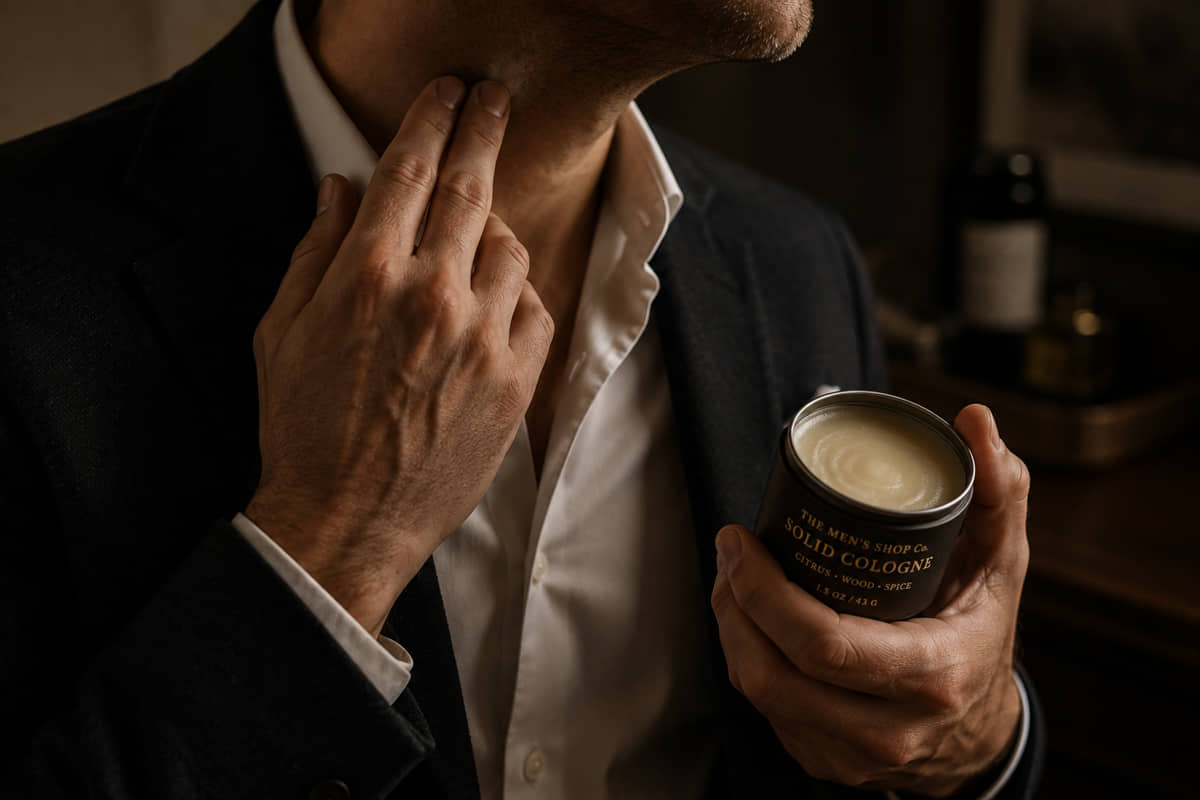
Two points. The sides of the neck, or the neck and the inside of one wrist. That is enough.
The measure of correct application is simple: someone should be able to notice your scent when they shake your hand, and not before. If a room can tell you have arrived, you have applied too much. Fragrance that announces itself is doing the opposite of what a well-kept man wants - it takes attention rather than earning it.
Your own nose is an unreliable judge here. Within twenty minutes you stop registering a scent you are wearing, which is why men who chase the feeling of freshness end up applying more and more of it. Trust the amount you decided on, not the amount you can still smell.
What to look for
Warm and woody wears better across more situations than sweet or sharp. Cedarwood gives structure and a dry, clean backbone. Amber gives warmth without sugar. Together they read as considered rather than fashionable, and they work in a meeting, at dinner and on a Saturday without any of those feeling like a compromise.
That is the reasoning behind our own cedarwood and amber signature - not because warm woods are novel, but because they are the least likely to feel wrong.
A solid cologne is worth knowing about, particularly if you travel. It applies with a fingertip, which makes over-application almost impossible. There is no cloud, no glass, and nothing to declare at security. It sits closer to the skin than a spray, which is usually the intention anyway.
A spray covers more ground and projects further. Neither is better. But a man who has ever arrived somewhere smelling of nothing because the bottle stayed at home will understand the appeal of something that fits in a jacket pocket.
Judge a fragrance an hour after you put it on, never in the shop. The first few minutes are the opening notes burning off - bright, loud and gone. What remains after sixty minutes is what you will actually wear all day.
Apply to moisturised skin. Fragrance holds to oil and evaporates off dry skin quickly. If your scent disappears by lunch, the fault is usually the skin it was applied to, not the bottle.
Two points, not six. The sides of the neck are enough. More application points do not make a scent last longer; they only make it louder in the first hour.
Do not keep fragrance in the bathroom. Heat, steam and light degrade it faster than anything else. A drawer or a wardrobe shelf will keep a bottle honest for years.
The usual mistakes
Applying more because you can no longer smell it. You stopped smelling it after twenty minutes. Everyone else did not. This single habit accounts for most of the men who are remembered for the wrong reason.
Spraying into the air and walking through it. It looks elegant and wastes most of the bottle on your carpet. What reaches you lands unevenly, mostly on fabric.
Applying to a shirt rather than skin. Fragrance is designed to develop on warm skin. On cotton it stays flat, and on silk or wool it can stain.
Buying on the opening. The first thirty seconds of any fragrance are engineered to sell it. Live with it for an hour before deciding.
Changing it constantly. A scent becomes yours through repetition. Switching every few months guarantees that it never does.
Scent is the last thing you put on and the first thing anyone notices. It is worth choosing once, properly, and then simply having - the way you have a watch you like and shoes that fit.
Yes, she notices. So does the client, and the friend you have not seen in two years, and the room you walk into on a Tuesday. But that is not really the reason to bother.
The reason is that a man who has decided how he wants to smell has made one more decision he no longer has to make. That is what being well kept actually is: not more effort every morning, but less - because the thinking was done in advance.